
Welcome to AZMedicalScience — a dedicated platform for healthcare professionals to access specialized scientific content and research.

Header Logo
  • Respiratory & Immunology
  • Cardiovascular, Renal & Metabolism
  • Oncology
  • Rare Disease

Welcome to AZMedical Science

AZMedical Science is a website developed by AstraZeneca to provide non-promotional, disease state education for healthcare professionals.


Please note that the content available on this website may vary depending on your location, in accordance with local regulatory requirements.


By clicking "Enter," you confirm that you are a licensed healthcare professional and understand the nature of this content.

I am an AstraZeneca authorized person

Exit
  • Evidence Base
  • Patients at Risk
  • Optimise Management
  • Resources for You

WHEN IT COMES TO COPD,
THERE’S MUCH MORE AT
THE HEART OF THE
MATTER

Could you be acting earlier in your patients' COPD treatment?

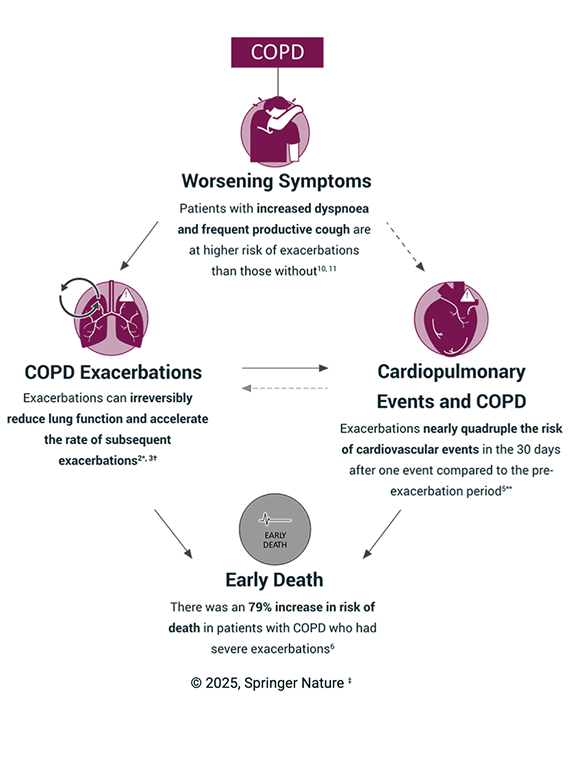
The lungs and the heart are fundamentally linked and work together.1 COPD mechanisms elevate the risk of both lung and heart events, including COPD exacerbations (or COPD flare-ups), cardiac events and death from these. In COPD patients, this elevated risk of lung and heart events is termed “cardiopulmonary risk.”2-7

Proactive treatment for your COPD patients may prevent exacerbations and reduce mortality by addressing cardiopulmonary risk.7-10 Through such proactive treatment, you could improve prognosis and prevent...

COPD-Associated Cardiopulmonary Risk

Learn about the latest evidence on the cardiopulmonary burden of COPD from Professor John Hurst, Respiratory Medicine at University College London and honorary consultant at Royal Free London NHS Foundation Trust:

Download the presentation

You’ll learn:

  • 1
    How worsening COPD symptoms and exacerbations can lead to cardiopulmonary events and early death
  • 2
    What the potential mechanisms of COPD-associated cardiopulmonary risk are
  • 3
    That adopting a preventative mindset can be effective, and be executed upon by identifying patients at-risk and optimising their management

Exacerbations are common for COPD patients, but they remain
under-recognised, under reported, and under-treated.12-14 And the
impact of exacerbations reaches beyond the lungs.4

  1. Classifications
  2. Quality of life
  3. Lung function
  4. Respiratory infections
  5. Cardiovascular (CV) Events
  6. Hospitalisations and early death

Exacerbations are a short-term worsening of one or more COPD symptoms requiring additional therapy13

According to the Global Initiative for Chronic Obstructive Lung Disease (GOLD), exacerbations can be categorised as mild (treated with short-acting beta-antagonists (SABAs) only); moderate (treated with SABAs plus antibiotics and / or oral corticosteroids); or severe (requiring hospitalisation or emergency room visit).9

A history of exacerbations is the strongest predictor of future exacerbation risk, with an impact that can also go beyond the lungs.10,15

There are approximately 392 million people globally that have COPD.16 Across the world, the average annual COPD exacerbation rate is greater than 0.5 per year.3,17-22

Over 70% of patients with COPD will experience at least one exacerbation within the first three years of diagnosis.17,23-25

The prognosis of patients with COPD depends largely on the frequency of exacerbations.36,37,38

Exacerbations are associated with a poor quality of life and increased prevalence of anxiety and depression among COPD patients25,26

A clinically meaningful worsening of quality of life has been observed in COPD patients who experienced a moderate-to-severe exacerbation.25

Despite their clinical and economic importance, COPD exacerbations are often inadequately prevented and undertreated.12

COPD has a significant impact on the psychological well-being of people affected. Based on a study conducted in Poland, patients with frequent COPD exacerbation with chronic bronchitis were shown to have a higher prevalence of depression and anxiety.26

Preventing exacerbations is fundamental in managing COPD.38,39

Just one moderate exacerbation can lead to decline in lung function27,28

A single moderate exacerbation has shown to double the rate of lung function decline.27

It has been documented within the first eight weeks post-exacerbation that lung function may not recover to pre-exacerbation levels.2

Most exacerbations are caused by respiratory infections. Infection triggered exacerbations have more severe outcomes.38,46

At least 70% of exacerbations are caused by bacterial and viral respiratory infections.38

About half are triggered by bacterial infections and the other half by viral infections.49,50

Infectious exacerbations were associated with:

  • more severe exacerbations than non-infectious41,46
  • prolonged recovery times, particularly when they began with cold or flu-like (viral) symptoms during the winter months36,47
  • longer hospitalisation periods, average 9 days for viral infections and 6 days for bacterial infections compared with non-infectious exacerbations44,45
  • having greater impairment of several lung function parameters than those with non-infectious exacerbations41,44

Co-infections with both bacteria and viruses also occur. These exacerbations can lead to more severe functional impairment and longer hospital stays.44,48

Viral infections can be the precipitating factor to bacterial infections. Respiratory viral infections target the epithelial cells of the lung and lead to desquamation, microvascular dilatation, edema, and inflammatory cell infiltrate. These changes predispose the lower airways to bacterial infections, because they interfere with mucociliary clearance and reduce the bacterial clearance due to macrophages.44

Even though the most frequent cause of exacerbations are respiratory infections, vaccination uptake remains suboptimal in COPD patients.38,39,40

Increased risk of CV events like heart attack and heart failure worsening may persist for up to one year due to damage from COPD exacerbations15

Cardiovascular conditions and COPD often co-exist and cardiovascular conditions increase the risk of death in COPD patients.4

Cardiac-related death represents a substantial proportion of reported causes of death in patients with COPD, especially in the milder forms of the disease.4

The risk of severe CV events or all-cause death is substantially increased in the first 30 days following both moderate and severe COPD exacerbations.5

Following a severe exacerbation, this risk remains raised for at least 12 months.15

After an exacerbation, there is an increased risk of a wide variety of CV events including acute coronary syndrome, heart failure decompensation, arrhythmias, pulmonary embolism, pulmonary artery hypertension, and stroke.15

Exacerbations can increase the risk of future COPD hospitalisations and death3

Patients with COPD die of both respiratory and non-respiratory causes, including CV-related causes.29

Just one moderate exacerbation has been associated with increasing the risk of hospitalisation by 21%.6

COPD severity, and frequent and more severe exacerbations are all related to an increased risk of mortality.6

Only 50% of patients were alive 3.6 years after their first severe exacerbation.3***

old-lady

Consider more proactive intervention before your patient’s next exacerbation

Download the flare-up checklist

Understanding exacerbation history is the best way to predict future risk.10 This tool can help your patients review their COPD symptoms and work with you to understand if a review of treatment options is required.

Download hospital discharge protocol

There is a high readmission rate for patients hospitalised for a COPD exacerbation, with evidence suggesting that COPD discharge bundles may aid towards reducing this.9,30

To look to improve patient outcomes, refer to this comprehensive COPD hospital discharge protocol in helping address readmission rates.

old-lady

It’s never too early to Act on COPD

Put prevention of exacerbation and early death at the centre of COPD management.

  1. American Lung Foundation. Heart-Lung Relationship. Blog, February 13, 2023. https://www.lung.org/blog/heart-lung-relationship
  2. Watz H, et al. Respir Res 2018;19:251
  3. Suissa S, et al. Thorax 2012;67:957–963
  4. Donaldson GC, et al. Chest 2010;137:1091–1097
  5. Kunisaki KM, et al. Am J Respir Crit Care Med 2018;198:51–57
  6. Rothnie KJ, et al. Am J Respir Crit Care Med 2018;198:464–471
  7. Hurst JR, et al. Eur J Int Med 2020;73:1–6
  8. Pullen R, et al. Int J Chron Obstruct Pulmon Dis 2021;16:2301–2322
  9. Global Initiative for Chronic Obstructive Lung Disease (GOLD). Global strategy for prevention, diagnosis and management of COPD. 2025. https://goldcopd.org/2025-gold-report/ (Accessed July 2025)
  10. Müllerová H, et al. BMJ Open 2014;4:e006171
  11. Hughes R, et al. Respir Med 2022;200:106921
  12. Singh D, et al. Int J Chron Obstruct Pulmon Dis 2021;16:3009–3016
  13. Barnes N, et al. BMC Pulm Med 2013;13:54
  14. Pavord ID, et al. Int J Chron Obstruct Pulmon Dis 2016;11(special issue):21–30
  15. Graul EL, et al. Am J Respir Crit Care Med 2023; doi: 10.1164/rccm.202307-1122OC (Epub ahead of print, Dec 21)
  16. Adeloye D, et al. Lancet Respir Med 2022;10:447–458
  17. Hurst JR, et al. N Engl J Med 2010;363(12):1128–1138
  18. ClinicalTrials.gov. NCT00292552. Accessed March 2024
  19. Wallace AE, et al. J Manag Care Spec Pharm 2019;25(2):205–217
  20. Koblizek V, et al. Eur Respir J 2017;49(5):1601446
  21. Jones PW, et al. Am J Respir Crit Care Med 2015;191:A2532
  22. Matsunaga K, et al. Respir Investig 2015;53(2):82–85
  23. Hoogendoorn M, et al. Int J Chron Obstruct Pulmon Dis 2017;12:3183–3194
  24. Tashkin DP, et al. N Engl J Med 2008;359(15):1543–1554
  25. Roche N, et al. Eur Respir J 2017;50:OA1487
  26. Kania A, et al. Int J Chron Obstruct Pulmon Dis 2018;13:1613–1621
  27. Halpin DMG, et al. Respir Med 2017;128:85–91
  28. Rothnie KJ, et al. Ann Am Thorac Soc 2018;15(8):935–946. doi: 10.1513/AnnalsATS.201710-815OC
  29. Mannino DM, et al. Respir Med 2006;100:115–122
  30. Hughes R, et al. Respir Med 2022;200:106921
  31. Bafadhel M, et al. Lancet Respir Med 2018;6:117–126
  32. Lindberg A, et al. Respir Med 2015;109:88–95
  33. Dransfield MT, et al. Am J Respir Crit Care Med 2017;195(3):324–330
  34. Westerik JAM, et al. Respir Res 2017;18:31
  35. Kessler R, et al. CHEST 2006;130(1):133–142
  36. Wedzicha JA, Mackay AJ, Singh R. COPD exacerbations: impact and prevention. Breathe 2013;9(6):434–440
  37. Ji Z, Jareño-Esteban JJ, de Miguel-Díez J. Role of Vaccines in COPD Patients. Open Respir Arch 2022;4(3):100191
  38. Simon S, Joean O, Welte T, Rademacher J. The role of vaccination in COPD: influenza, SARS-CoV-2, pneumococcus, pertussis, RSV and varicella zoster virus. Eur Respir Rev 2023;32(169)
  39. Hogea S-P, Tudorache E, Fildan AP, Fira-Mladinescu O, Marc M, Oancea C. Risk factors of chronic obstructive pulmonary disease exacerbations. Clin Respir J 2020;14:183–197
  40. Linden D, Guo-Parke H, Coyle PV, Fairley D, McAuley DF, Taggart CC, Kidney J. Respiratory viral infection: a potential "missing link" in the pathogenesis of COPD. Eur Respir Rev 2019;28(151):180063
  41. Papi A, Bellettato CM, Braccioni F, Romagnoli M, Casolari P, Caramori G, Fabbri LM, Johnston SL. Infections and airway inflammation in chronic obstructive pulmonary disease severe exacerbations. Am J Respir Crit Care Med 2006;173(10):1114–1121. doi: 10.1164/rccm.200506-859OC
  42. Bouquet J, Tabor DE, Silver JS, Nair V, Tovchigrechko A, Griffin MP, et al. Microbial burden and viral exacerbations in a longitudinal multicenter COPD cohort. Respir Res 2020;21:1–13. doi: 10.1186/s12931-020-01340-0
  43. Mathioudakis AG, Janssens W, Sivapalan P, Singanayagam A, Dransfield MT, Jensen J-US, et al. Acute exacerbations of chronic obstructive pulmonary disease: in search of diagnostic biomarkers and treatable traits. Thorax 2020;75(6):520–527
  44. Frickmann H, Jungblut S, Hirche TO, Groß U, Kuhns M, Zautner AE. The influence of virus infections on the course of COPD. Eur J Microbiol Immunol (Bp) 2012;2(3):176–185. doi: 10.1556/EuJMI.2.2012.3.2
  45. Dimopoulos G, Lerikou M, Tsiodras S, Chranioti A, Perros E, Anagnostopoulou U, Armaganidis A, Karakitsos P. Viral epidemiology of acute exacerbations of chronic obstructive pulmonary disease. Pulm Pharmacol Ther 2012;25(1):12–18. doi: 10.1016/j.pupt.2011.08.004
  46. Bafadhel M, McKenna S, Terry S, et al. Acute exacerbations of chronic obstructive pulmonary disease: identification of biologic clusters and their biomarkers. Am J Respir Crit Care Med 2011;184(6):662–671
  47. Aaron SD, Donaldson GC, Whitmore GA, Hurst JR, Ramsay T, Wedzicha JA. Time course and pattern of COPD exacerbation onset. Thorax 2012;67(3):238–243
  48. Wilkinson TM, Hurst JR, Perera WR, Wilks M, Donaldson GC, Wedzicha JA. Effect of interactions between lower airway bacterial and rhinoviral infection in exacerbations of COPD. Chest 2006;129(2):317–324
  49. Falsey AR, Walsh EE, Esser MT, Shoemaker K, Yu L, Griffin MP. Respiratory syncytial virus-associated illness in adults with advanced chronic obstructive pulmonary disease and/or congestive heart failure. J Med Virol 2019;91:65–71
  50. Sethi S, Murphy TF. Infection in the pathogenesis and course of chronic obstructive pulmonary disease. N Engl J Med 2008;359:2355–2365

* In some patients, lung function did not recover to pre-exacerbation levels by eight weeks after the start of the moderate exacerbation

†Following a severe exacerbation, the rate of severe exacerbation increased and the time to subsequent exacerbations decreased

‡Singh D, Han MK, Hawkins NM, et al. Implications of Cardiopulmonary Risk for the Management of COPD: A Narrative Review. Adv Ther (2024). https://doi.org/10.1007/s12325-024-02855-4

**In a study conducted on patients with moderately severe COPD and rigorously adjudicated CVD events

***Cohort study evaluating severe COPD exacerbations and their association with mortality in 73,106 patients with their first severe COPD exacerbation requiring hospitalisation (patients identified 1990–2005, followed until death or 31 March 2007)

****Irreversibly reduce lung function

*****The relative risk of MI returned to near baseline, similar to any other post-exacerbation time interval

Z4-85812 Last Updated August 2026

Connessiallasalute.it

This site is intended for healthcare professionals


ASTRAZENECA Z4-85831 | 8/2026 |  ©ASTRAZENECA 2025 ALL RIGHTS RESERVED


Cookies

Contact Us

Privacy Notice