


- American Lung Foundation. Heart-Lung Relationship. Blog, February 13, 2023. https://www.lung.org/blog/heart-lung-relationship
- Watz H, et al. Respir Res 2018;19:251
- Suissa S, et al. Thorax 2012;67:957–963
- Donaldson GC, et al. Chest 2010;137:1091–1097
- Kunisaki KM, et al. Am J Respir Crit Care Med 2018;198:51–57
- Rothnie KJ, et al. Am J Respir Crit Care Med 2018;198:464–471
- Hurst JR, et al. Eur J Int Med 2020;73:1–6
- Pullen R, et al. Int J Chron Obstruct Pulmon Dis 2021;16:2301–2322
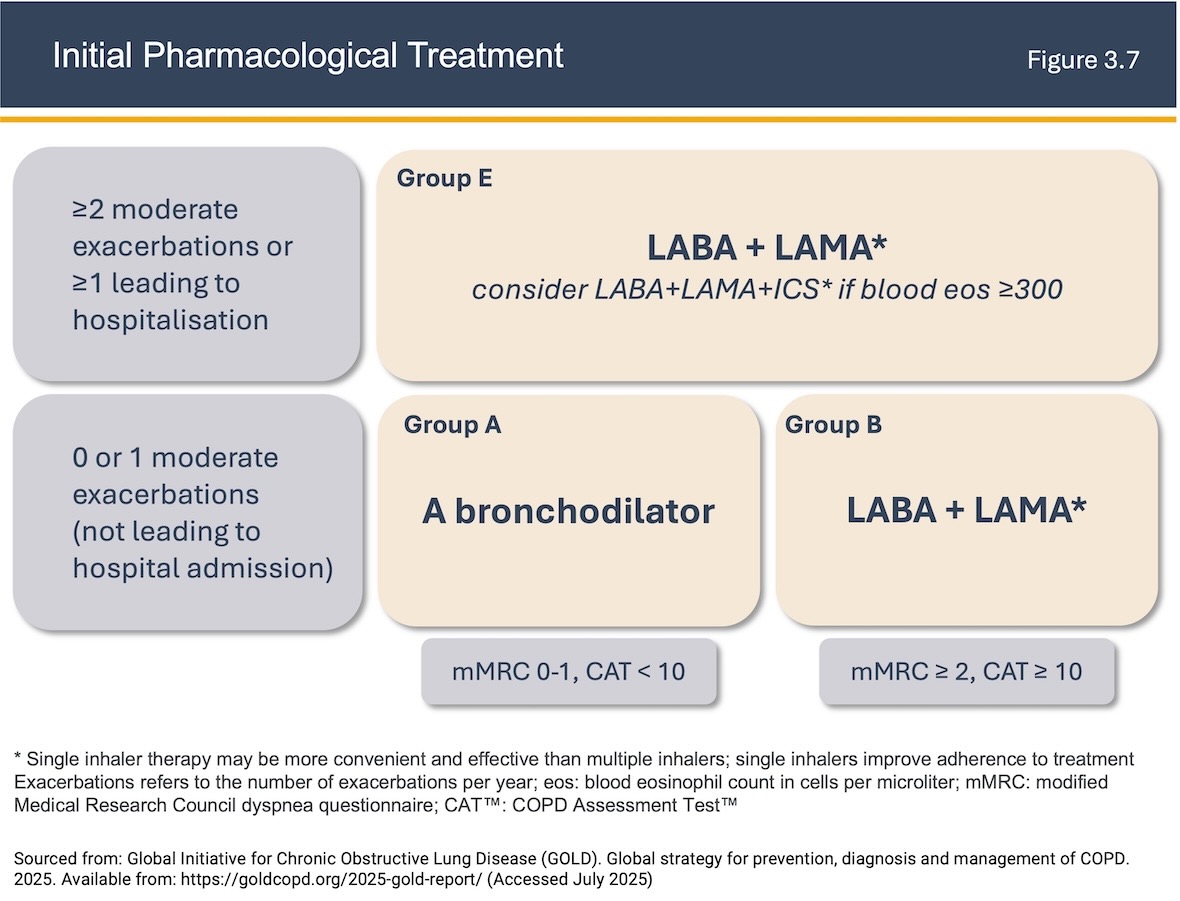
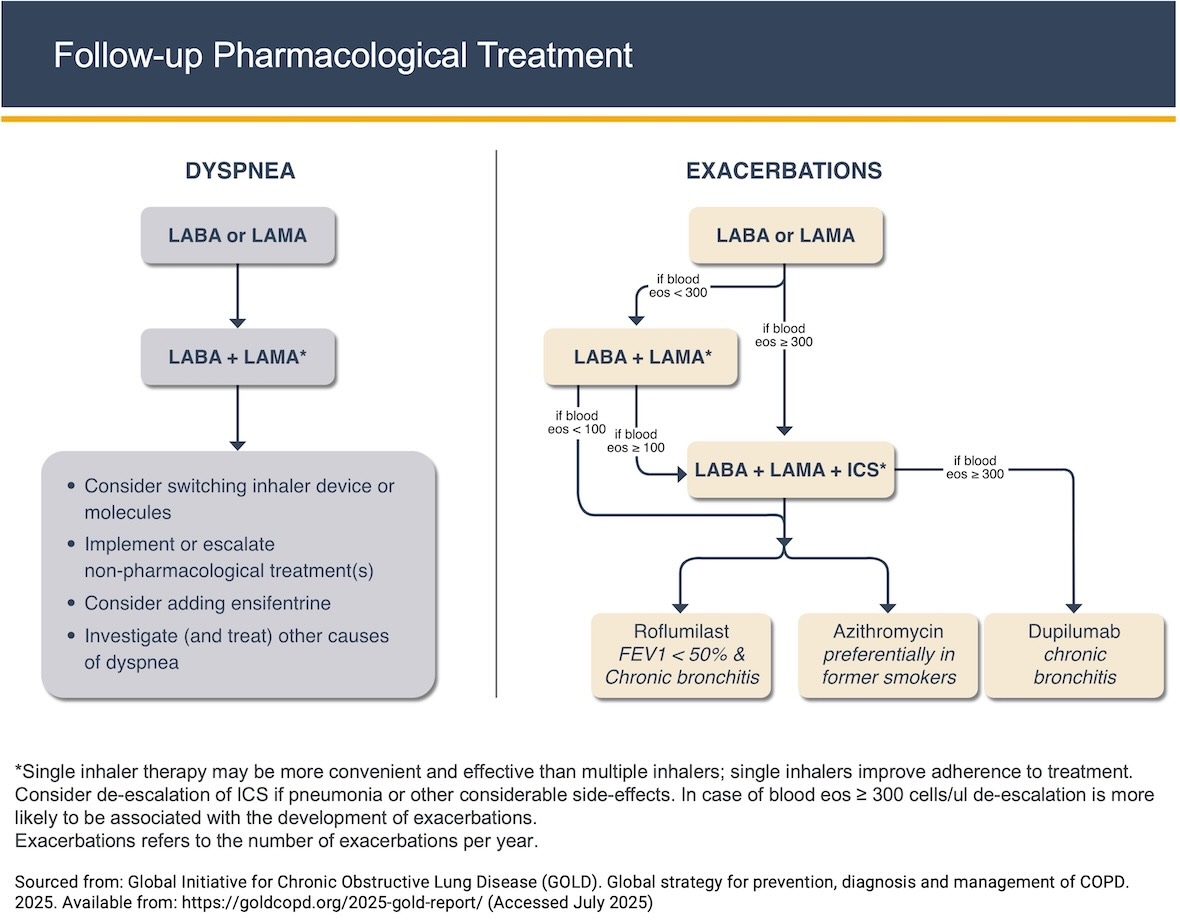
- Global Initiative for Chronic Obstructive Lung Disease (GOLD). Global strategy for prevention, diagnosis and management of COPD. 2025. https://goldcopd.org/2025-gold-report/ (Accessed July 2025)
- Müllerová H, et al. BMJ Open 2014;4:e006171
- Hughes R, et al. Respir Med 2022;200:106921
- Singh D, et al. Int J Chron Obstruct Pulmon Dis 2021;16:3009–3016
- Barnes N, et al. BMC Pulm Med 2013;13:54
- Pavord ID, et al. Int J Chron Obstruct Pulmon Dis 2016;11(special issue):21–30
- Graul EL, et al. Am J Respir Crit Care Med 2023; doi: 10.1164/rccm.202307-1122OC (Epub ahead of print, Dec 21)
- Adeloye D, et al. Lancet Respir Med 2022;10:447–458
- Hurst JR, et al. N Engl J Med 2010;363(12):1128–1138
- ClinicalTrials.gov. NCT00292552. Accessed March 2024
- Wallace AE, et al. J Manag Care Spec Pharm 2019;25(2):205–217
- Koblizek V, et al. Eur Respir J 2017;49(5):1601446
- Jones PW, et al. Am J Respir Crit Care Med 2015;191:A2532
- Matsunaga K, et al. Respir Investig 2015;53(2):82–85
- Hoogendoorn M, et al. Int J Chron Obstruct Pulmon Dis 2017;12:3183–3194
- Tashkin DP, et al. N Engl J Med 2008;359(15):1543–1554
- Roche N, et al. Eur Respir J 2017;50:OA1487
- Kania A, et al. Int J Chron Obstruct Pulmon Dis 2018;13:1613–1621
- Halpin DMG, et al. Respir Med 2017;128:85–91
- Rothnie KJ, et al. Ann Am Thorac Soc 2018;15(8):935–946. doi: 10.1513/AnnalsATS.201710-815OC
- Mannino DM, et al. Respir Med 2006;100:115–122
- Hughes R, et al. Respir Med 2022;200:106921
- Bafadhel M, et al. Lancet Respir Med 2018;6:117–126
- Lindberg A, et al. Respir Med 2015;109:88–95
- Dransfield MT, et al. Am J Respir Crit Care Med 2017;195(3):324–330
- Westerik JAM, et al. Respir Res 2017;18:31
- Kessler R, et al. CHEST 2006;130(1):133–142
- Wedzicha JA, Mackay AJ, Singh R. COPD exacerbations: impact and prevention. Breathe 2013;9(6):434–440
- Ji Z, Jareño-Esteban JJ, de Miguel-Díez J. Role of Vaccines in COPD Patients. Open Respir Arch 2022;4(3):100191
- Simon S, Joean O, Welte T, Rademacher J. The role of vaccination in COPD: influenza, SARS-CoV-2, pneumococcus, pertussis, RSV and varicella zoster virus. Eur Respir Rev 2023;32(169)
- Hogea S-P, Tudorache E, Fildan AP, Fira-Mladinescu O, Marc M, Oancea C. Risk factors of chronic obstructive pulmonary disease exacerbations. Clin Respir J 2020;14:183–197
- Linden D, Guo-Parke H, Coyle PV, Fairley D, McAuley DF, Taggart CC, Kidney J. Respiratory viral infection: a potential "missing link" in the pathogenesis of COPD. Eur Respir Rev 2019;28(151):180063
- Papi A, Bellettato CM, Braccioni F, Romagnoli M, Casolari P, Caramori G, Fabbri LM, Johnston SL. Infections and airway inflammation in chronic obstructive pulmonary disease severe exacerbations. Am J Respir Crit Care Med 2006;173(10):1114–1121. doi: 10.1164/rccm.200506-859OC
- Bouquet J, Tabor DE, Silver JS, Nair V, Tovchigrechko A, Griffin MP, et al. Microbial burden and viral exacerbations in a longitudinal multicenter COPD cohort. Respir Res 2020;21:1–13. doi: 10.1186/s12931-020-01340-0
- Mathioudakis AG, Janssens W, Sivapalan P, Singanayagam A, Dransfield MT, Jensen J-US, et al. Acute exacerbations of chronic obstructive pulmonary disease: in search of diagnostic biomarkers and treatable traits. Thorax 2020;75(6):520–527
- Frickmann H, Jungblut S, Hirche TO, Groß U, Kuhns M, Zautner AE. The influence of virus infections on the course of COPD. Eur J Microbiol Immunol (Bp) 2012;2(3):176–185. doi: 10.1556/EuJMI.2.2012.3.2
- Dimopoulos G, Lerikou M, Tsiodras S, Chranioti A, Perros E, Anagnostopoulou U, Armaganidis A, Karakitsos P. Viral epidemiology of acute exacerbations of chronic obstructive pulmonary disease. Pulm Pharmacol Ther 2012;25(1):12–18. doi: 10.1016/j.pupt.2011.08.004
- Bafadhel M, McKenna S, Terry S, et al. Acute exacerbations of chronic obstructive pulmonary disease: identification of biologic clusters and their biomarkers. Am J Respir Crit Care Med 2011;184(6):662–671
- Aaron SD, Donaldson GC, Whitmore GA, Hurst JR, Ramsay T, Wedzicha JA. Time course and pattern of COPD exacerbation onset. Thorax 2012;67(3):238–243
- Wilkinson TM, Hurst JR, Perera WR, Wilks M, Donaldson GC, Wedzicha JA. Effect of interactions between lower airway bacterial and rhinoviral infection in exacerbations of COPD. Chest 2006;129(2):317–324
- Falsey AR, Walsh EE, Esser MT, Shoemaker K, Yu L, Griffin MP. Respiratory syncytial virus-associated illness in adults with advanced chronic obstructive pulmonary disease and/or congestive heart failure. J Med Virol 2019;91:65–71
- Sethi S, Murphy TF. Infection in the pathogenesis and course of chronic obstructive pulmonary disease. N Engl J Med 2008;359:2355–2365
* In some patients, lung function did not recover to pre-exacerbation levels by eight weeks after the start of the moderate exacerbation
†Following a severe exacerbation, the rate of severe exacerbation increased and the time to subsequent exacerbations decreased
‡Singh D, Han MK, Hawkins NM, et al. Implications of Cardiopulmonary Risk for the Management of COPD: A Narrative Review. Adv Ther (2024). https://doi.org/10.1007/s12325-024-02855-4
**In a study conducted on patients with moderately severe COPD and rigorously adjudicated CVD events
***Cohort study evaluating severe COPD exacerbations and their association with mortality in 73,106 patients with their first severe COPD exacerbation requiring hospitalisation (patients identified 1990–2005, followed until death or 31 March 2007)
****Irreversibly reduce lung function
*****The relative risk of MI returned to near baseline, similar to any other post-exacerbation time interval