Welcome to AZMedicalScience — a dedicated platform for healthcare professionals to access specialized scientific content and research.

Header Logo
  • Respiratory & Immunology
  • Cardiovascular, Renal & Metabolism
  • Oncology
  • Rare Disease

Welcome to AZMedical Science

AZMedical Science is a website developed by AstraZeneca to provide non-promotional, disease state education for healthcare professionals.


Please note that the content available on this website may vary depending on your location, in accordance with local regulatory requirements.


By clicking "Enter," you confirm that you are a licensed healthcare professional and understand the nature of this content.

I am an AstraZeneca authorized person

Exit

Inflammation
in COPD

Explore the latest in COPD science
  • Home
  • Burden of COPD
  • Inflammation in COPD
  • Mucus dysfunction in COPD
  • IL-33 in COPD
  • Resources

Snapshot

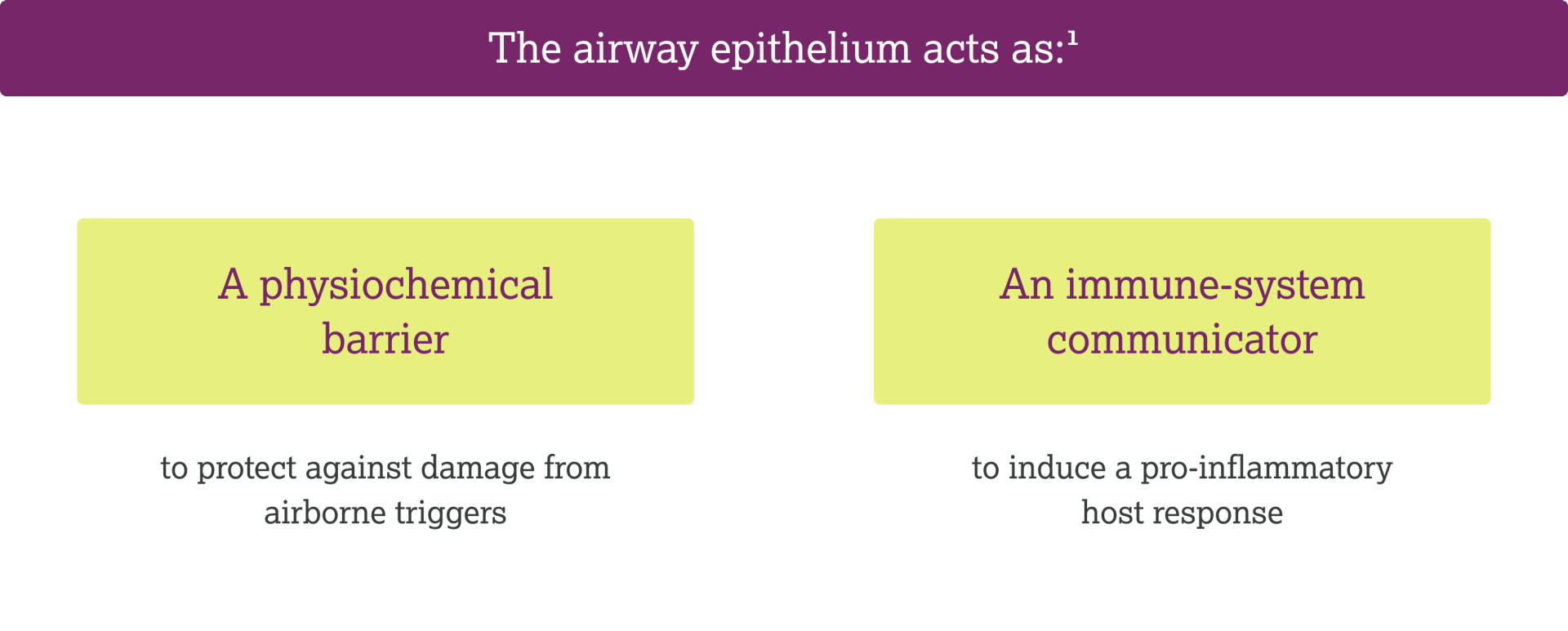
The airway epithelium functions as a physiochemical barrier and immune communicator through the release
of alarmins1–3

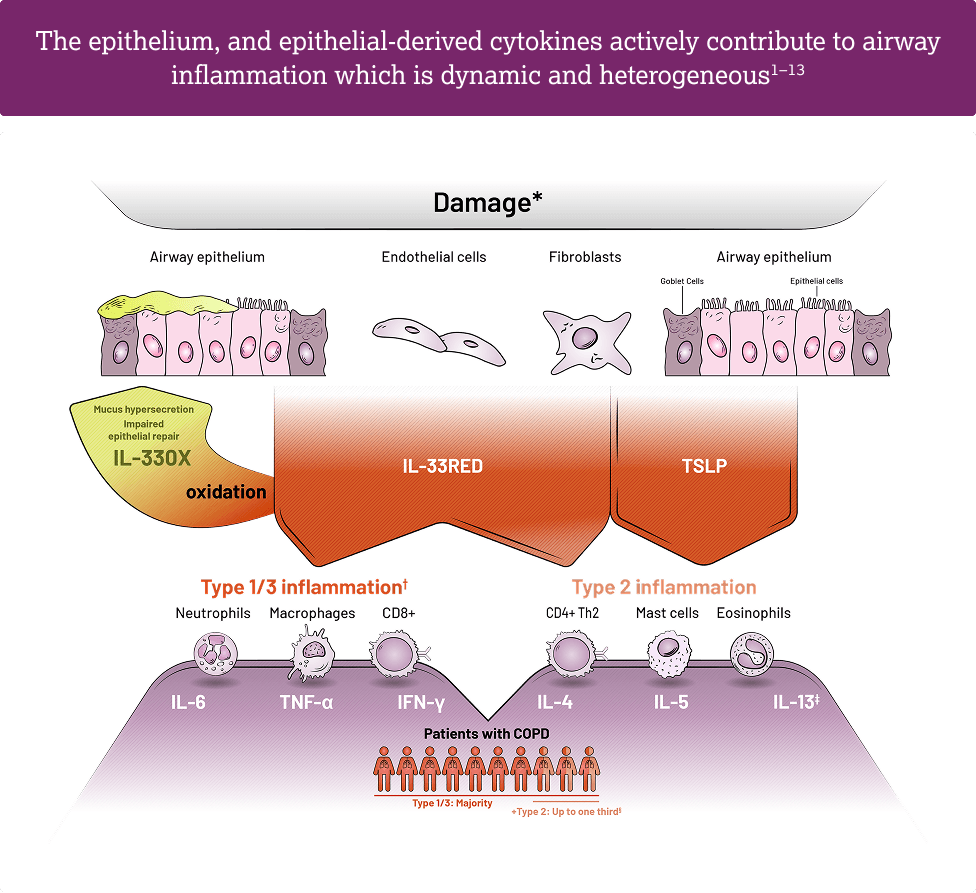
Upstream alarmins drive the release of downstream cytokines, including IL-6,
IL-5, IL-4 and IL-13, which also contribute to COPD pathophysiology3

COPD airway inflammation is heterogeneous, most commonly involving Type 1/3 pathways, with Type 2 inflammation present in a subset of patients1

Airway epithelial barrier function is central to the progression of COPD1

View the data

Within the complex and heterogeneous inflammatory environment of COPD, multiple alarmins and cytokines, including IL-33, TSLP, IL-4, IL-5 and IL-13, play a pivotal role in the inflammatory cascade1–13

View the data

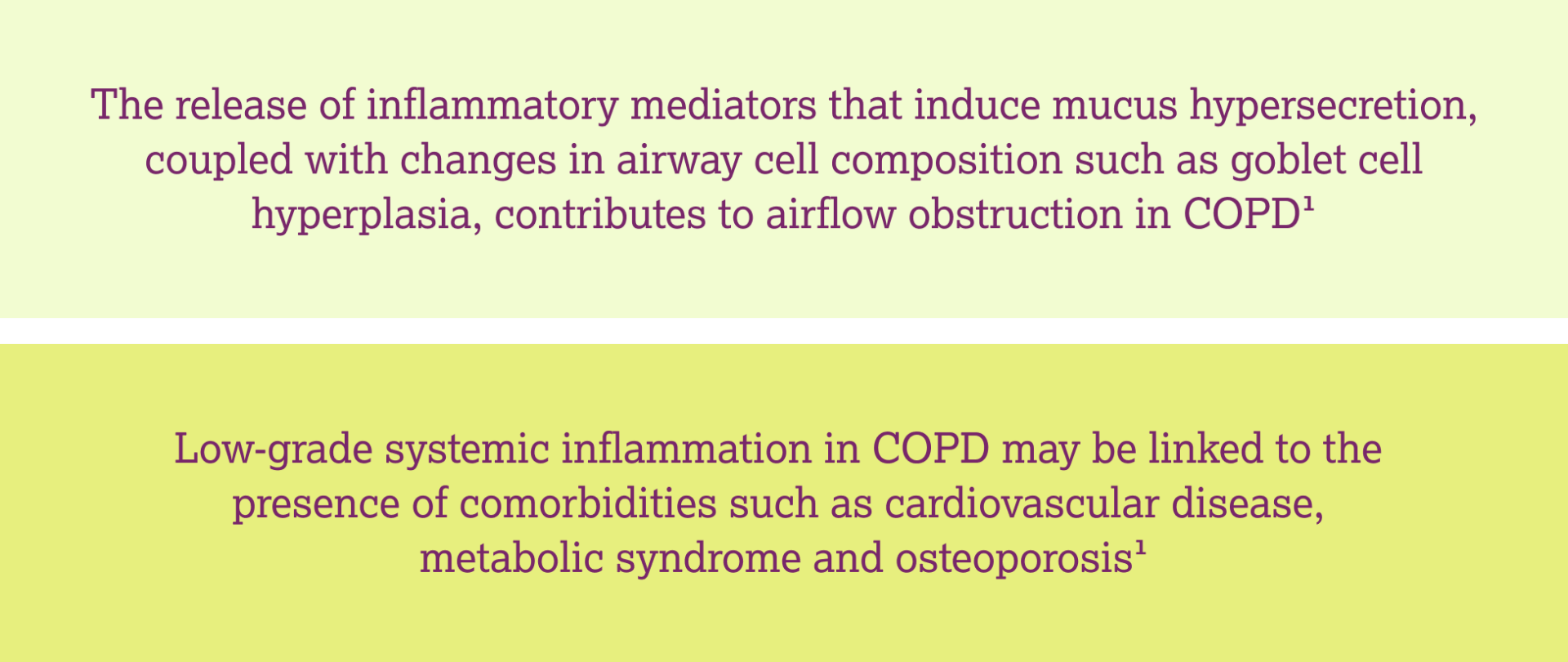
Inflammation drives disease pathogenesis, influences outcomes and may contribute to
comorbidity burden1

View the data
  1. <h4>Over half of patients with COPD receiving triple inhaled therapy have been shown to continue to experience exacerbations<sup>1,2</sup></h4>
  2. <h4>Over half of patients with COPD receiving triple inhaled therapy have been shown to continue to experience exacerbations<sup>1,2</sup></h4>
  3. <h4>Over half of patients with COPD receiving triple inhaled therapy have been shown to continue to experience exacerbations<sup>1,2</sup></h4>

Burden of COPD

Previous

Mucus dysfunction in COPD

Next

Frequently asked questions

What does ‘dysregulated IL-33’ mean?

IL‑33 is released upon stress or cell damage to initiate a host response—what was adaptive turns maladaptive or ‘dysregulated’ when its levels chronically surpass buffering mechanisms and signalling is persistent1–8

How does smoking affect the IL-33 pathway in patients with COPD?

In COPD, smoking status affects the IL‑33 axis—former smokers show elevated IL-33 compared to current smokers, while current smokers show reduced sST2 and more oxidized IL‑33, indicating aberrant IL‑33–ST2 signalling in both groups9–12

How does the role of IL-33 in COPD differ from other epithelial cytokines?

Damage to the epithelium triggers the release of upstream, alarmin cytokines. IL-33 is pre-formed, rapidly released and initiates a broad inflammatory cascade encompassing Type 1, Type 2 and Type 3 responses1,13,14

What evidence would suggest my patient with COPD has dysregulated IL-33 signalling?

Frequent exacerbations, productive cough and persistent airway/systemic inflammation may suggest heightened IL‑33

pathway activity15–17

What are the potential consequences of dysregulated IL-33 signalling?

IL-33 through its dual forms can drive Type 1 and 3 and Type 2 (eosinophilic, subset) inflammation, and mucus dysfunction, which are key drivers of COPD pathogenesis1–3,12,15

What is mucus dysfunction and what is the impact for patients with COPD?

Mucus dysfunction is the pathological changes in mucus volume, composition and clearance, the airway manifestations of these pathological changes, and the downstream

clinical consequences12,15,18–25

  1. sss
  2. sss
  3. sss
  4. sss
  5. sss
  6. sss

  1. Cayrol C. Cells. 2021;11(1):107
  2. Calderon AA, et al. Eur Respir Rev. 2023;32(167):220144
  3. Brightling CE, et al. Eur Respir J. 2019;54(6):1900651
  4. England E, et al. Sci Rep. 2023;13(1):9825
  5. Rabe KF, et al. Am J Respir Crit Care Med. 2023;208(4):395–405
  6. Keddache S, et al. Clin Immunol. 2021;229:108798
  7. Scott IC, et al. Biochem Soc Trans. 2018;46(5):1345–1353
  8. Burgoyne RA, et al. Cells. 2021;10(10):2763
  9. Abdo M, et al. Eur Respir J. 2024;64(3):2400347
  10. Faiz A, et al. Am J Respir Crit Care Med. 2023;208(10):1075–1087
  11. Faiz A, et al. Am J Respir Crit Care Med. 2023;208(Suppl.):1075–1087
  12. Strickson S, et al. Eur Respir J. 2023;62(3):2202210
  13. Cayrol C, Girard JP. Cytokine. 2022;156:155891
  14. Varricchi G, et al. Eur Respir J. 2024;63(4):2301619
  15. Diaz AA, et al. JAMA. 2023;329(21):1832–9
  16. Shen Y, et al. Int J Chron Obstruct Pulmon Dis. 2018;13:399–407
  17. Rodrigues SO, et al. Pharmaceuticals (Basel). 2021;14(10):979
  18. Fahy JV, Dickey BF. N Engl J Med. 2010;363(23):2233–2247
  19. Stott-Miller M, et al. Int J Chron Obstruct Pulmon Dis. 2020;15:2467–2476
  20. Hughes R, et al. Respir Med. 2022;200:106921
  21. Choate R, et al. Chronic Obstr Pulm Dis. 2020;7(1):49–59
  22. Cook N, et al. Int J Chron Obstruct Pulmon Dis. 2019;14:1365–1376
  23. Tian PW, Wen FQ. J Transl Int Med. 2015;3(3):89-92
  24. Mettler SK, et al. N Engl J Med. 2025;392(19):1973–1975
  25. Zhou D, et al. Expert Rev Respir Med. 2025:1–7

Stay ahead

Sign up for the latest updates on new content

Sign up

Back to top

CD, cluster of differentiation; COPD, chronic obstructive pulmonary disease; ECP, eosinophil cationic protein; EPX, eosinophil peroxidase; IFN, interferon; IL, interleukin; MMP, matrix metalloproteinase; MPO, myeloperoxidase; NETs, neutrophil extracellular traps; Th, T-helper cell; TNF, tumour necrosis factor; TSLP, thymic stromal lymphopoietin

  1. Wechsler ME, Wells JM. ERJ Open Res. 2024;10:00177–02024
  2. Saber Cherif L, et al. Eur J Immunol. 2025;55(1):e202451480
  3. Gabryelska A, et al. Front Immunol. 2019;10:692
  4. Marcuccio G, et al. Front Med Lausanne. 2025;12:1550716
  5. Strickson S, et al. Eur Respir J. 2023;62(3):2202210
  6. Keddache S, et al. Clin Immunol. 2021;229:108798
  7. Brightling CE, et al. Eur Respir J. 2019;54(6):1900651
  8. Calderon AA, et al. Eur Respir Rev. 2023;32(167):220144
  9. Zhou Y, Xu Z, Liu Z. J Transl Med. 2023;21:902
  10. MacNee W. Proc Am Thorac Soc 2005;2:258–26
  11. Rabe KF, et al. Am J Respir Crit Care Med. 2023;208(4):395–405
  12. Paliogiannis P, et al. Eur Respir Rev 2018;27:17011
  13. Cohen ES, et al. Nat Commun 2015;6:8327

fifth-modal fifth-modal

fifth-modal fifth-modal

The role of IL-25 in the pathophysiology of COPD remains largely unknown. Although IL-25 has been shown to play a role in several inflammatory respiratory conditions, the potential link between IL-25 expression and clinical manifestations of COPD requires further research.


Upstream cytokines drive the release of additional cytokines, including IL-6, IL-5, IL-4 and IL-13 which also play a role in COPD pathophysiology.


*Damage induced by smoke, pollutants, and viral or bacterial exposure; †Type 3 inflammation is represented in simplified form - Th17/IL-17-associated biology underpins this pathway; ‡IL-13 drives mucus secretion in COPD; §Identified through elevated EOS.


This illustration is a simplified schematic and not a complete overview of all immune processes involved. Cytokines are shown as representative mediators associated with each inflammatory pathway and should not be interpreted as being exclusively produced by the adjacent cell type. Multiple immune and structural cells may contribute to these cytokine networks.


Abbreviations: COPD, chronic obstructive pulmonary disease; EOS, eosinophils, IFN, interferon gamma; IL, interleukin; OX, oxidised; RED, reduced; TNF-α, tumor necrosis factor alpha; TSLP, thymic stromal lymphopoietin.


Figure was developed by AstraZeneca based on data from references.1–13

fifth-modal fifth-modal

Z4-86369 | Date of preparation: August 2026

Sign up below to be notified about new resource

Connessiallasalute.it

This site is intended for healthcare professionals


ASTRAZENECA Z4-85831 | 8/2026 |  ©ASTRAZENECA 2025 ALL RIGHTS RESERVED


Cookies

Contact Us

Privacy Notice